
Study in China with Aalokbortika Education
Bachelor’s, master’s, PhD, MBBS and Chinese-language programmes at public Chinese universities, with full scholarships available. We guide international students from choosing a university to getting the X1 student visa.
- Chinese Government (CSC) Scholarship
- English- & Chinese-taught programmes
- September intake (some March)
- X1 student visa
China is home to many of Asia’s top-ranked universities and hosts students from more than 190 countries. Public universities offer bachelor’s, master’s and doctoral degrees taught in English or Chinese, and the Chinese Government Scholarship (CSC) can cover tuition, housing, a monthly stipend and medical insurance. Aalokbortika Education helps students from Bangladesh, Pakistan, Nepal, Egypt, Mauritania, Uzbekistan, Yemen, Afghanistan and other countries apply.
Start here
Our guides cover each stage of studying in China.
 GuideWhy study in ChinaDegrees, costs, safety and life as an international student.
 GuideProgrammes in ChinaBachelor’s, master’s, PhD, MBBS and language programmes.
 ScholarshipsScholarships in ChinaCSC, provincial and university scholarships explained.
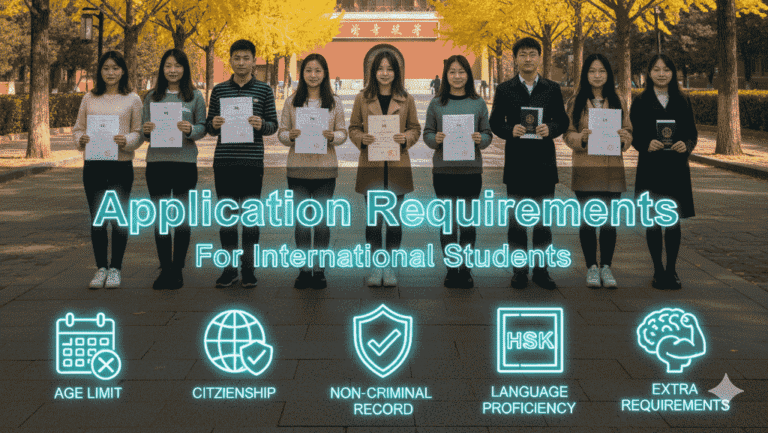 ChecklistApplication requirementsThe documents Chinese universities ask for.ExamCSCA exam guideThe admission test for bachelor’s applicants: dates, subjects, fees.ListOur partner universitiesChinese universities we work with, by city and subject.
Why study in China?
- Recognised degrees from public universities, many ranked among the best in Asia, especially in engineering, computer science and medicine.
- Full scholarships from the Chinese government, provinces, cities and universities, for bachelor’s to PhD.
- Lower costs than most Western countries: tuition can start from about 10,000 yuan a year and dormitories from about 2,000 yuan a year.
- English-taught options at bachelor’s, master’s and PhD level, plus Chinese-taught programmes with a foundation or language year.
- Career value: Mandarin skills and links with Chinese companies, which are major investors across South Asia, the Middle East, Africa and Central Asia.
Read more in Why China.
Programmes and intakes
| Level | Length | Language | Main requirements |
|---|---|---|---|
| Chinese language / foundation year | 1 semester to 1 year | Chinese | High school certificate |
| Bachelor’s | 4 years (MBBS 6 years incl. internship) | English or Chinese | Higher secondary / A levels; CSCA score where required; English proof or HSK 4 for Chinese-taught; age under 25 for CSC |
| Master’s | 2–3 years | English or Chinese | Bachelor’s degree; 2 recommendation letters; English proof or HSK 4; age under 35 for CSC |
| PhD | 3–4 years | English or Chinese | Master’s degree; research proposal; 2 recommendation letters; age under 40 for CSC |
The main intake is September; some universities also take students in March. Medicine (MBBS) in English is only offered by universities on China’s Ministry of Education list, so check before you apply. See Programmes in China for subject options.
Scholarships
The Chinese Government Scholarship, run by the China Scholarship Council (CSC), is the best-known full scholarship. A full award covers:
| Coverage | |
|---|---|
| Tuition | Fully covered |
| Accommodation | Free university dormitory or a housing allowance |
| Monthly stipend | 2,500 yuan (bachelor’s), 3,000 yuan (master’s), 3,500 yuan (PhD) |
| Medical insurance | Comprehensive insurance (800 yuan a year) |
- How to apply: through a Chinese university that hosts CSC students, or through the Chinese embassy or government channel in your country, on campuschina.org. Applications usually open in the winter for the next September intake.
- Bachelor’s applicants to CSC universities need a CSCA score.
- Other scholarships: provincial and city government scholarships, and university scholarships that cover full or partial tuition, often with easier competition.
Compare them in Scholarships in China.
Costs for self-funded students
| Item | Typical cost |
|---|---|
| Tuition | From about 10,000 yuan a year; English-taught, medical (MBBS) and big-city programmes cost more |
| University dormitory | From about 2,000 yuan a year (shared room) |
| Medical insurance | About 800 yuan a year (required) |
| Living costs | Food, transport and phone depend on the city and your lifestyle; smaller cities cost much less than Beijing or Shanghai |
Fees differ by university, subject and teaching language. Beijing, Shanghai and Shenzhen are the most expensive cities. We give you the exact tuition and dormitory fees for each university you apply to.
How to apply and get your visa
- Choose a programmePick the university, subject and teaching language, and check the requirements, including whether you need the CSCA.You + Aalokbortika
- Prepare documentsPassport, notarised certificates and transcripts, study plan, physical examination form, police certificate and language proof.You, with our checklist
- ApplySelf-funded: on the university’s portal. Scholarship: through the university or on campuschina.org (CSC).Aalokbortika
- Admission notice & JW formThe university sends your admission notice and JW201 (scholarship) or JW202 (self-funded) visa form.University
- X1 student visaApply at the Chinese embassy or visa centre in your country with your passport, admission notice and JW form.You, with our help
- Arrive & registerRegister at the university and apply for your residence permit within 30 days of arrival.You + University
Blue: before admission. Orange: admission, visa and arrival.
Typical documents: passport (valid at least 12 months after the start date), notarised highest certificate and transcripts, Foreigner Physical Examination Form, police clearance certificate, study plan or research proposal, language proof, and a CSCA score for bachelor’s applicants. See the full application requirements.
Universities we work with
Some of the 60+ Chinese universities and colleges we work with. Ask us about programmes, fees and scholarships at any of them.
- Chang’an University
- China Jiliang University
- China Pharmaceutical University
- China University of Mining and Technology
- China University of Petroleum
- China West Normal University
- Dalian University of Technology
- Dongguan University of Technology
- Fujian Medical University
- Hangzhou Normal University
- Harbin Engineering University
- Harbin Institute of Technology, Shenzhen
- Jiangsu University
- Jiaxing University
- Jilin International Studies University
- Jinzhou Medical University
- Nanjing Institute of Technology
- Nanjing Medical University
- Nanjing Tech University
- Nanjing University of Information Science and Technology
- Nantong University
- NingboTech University
- Ningbo University
- Ningxia Medical University
- Northwestern Polytechnical University
- Shenyang City University
- Southern Medical University
- University of Electronic Science and Technology of China
- Wuxi Institute of Technology
- Wuxi University
Orange: our guide to the university. Blue: programmes, fees and online application on our portal. Green: ask on WhatsApp. See all partner universities.
How we help
- University and scholarship match: we shortlist universities that fit your grades, budget and subject, and tell you which scholarships you can apply for.
- Documents: we check your certificates, notarisation and attestation, study plan and recommendation letters. Rules differ by country, so we follow the ones for yours.
- Applications: we submit your university and scholarship applications and follow up with admissions offices.
- CSCA preparation: courses and free mock tests on Aalokbortika Academy for bachelor’s applicants.
- Visa and arrival: we prepare your X1 visa file and brief you on registration and the residence permit.
Message us on WhatsApp to start, or visit our office at 16/1 Sah Para Road, Magura Sadar, Magura 7600, Bangladesh. Education agents can join our partnership program.
Frequently asked questions
Can I study in China in English?
Yes. Many public universities teach bachelor’s, master’s and PhD programmes in English, including MBBS at approved medical universities. Chinese-taught programmes usually require HSK 4, or a one-year Chinese-language course first.
Do I need the CSCA exam?
Most bachelor’s applicants to universities in the Chinese Government Scholarship programme need a CSCA score. Master’s and PhD applicants do not. See our CSCA guide.
When should I apply?
Start 9–12 months before your intake. Scholarship applications for September usually open in winter and close between January and April, depending on the university. Self-funded places often stay open until early summer.
Can I work while studying in China?
Part-time work or internships are only allowed with permission from your university and an update to your residence permit. Do not plan to cover your costs by working.
Which visa do I need?
An X1 student visa for studies longer than 180 days. You apply with your passport, admission notice and JW201 or JW202 form, then convert it into a residence permit within 30 days of arriving in China.
Sources: Chinese Government Scholarship notices (Campus China / Chinese embassies, 2026–2027 cycle); China University of Geosciences, Chinese Government Scholarships; Wuhan University, Student visa; tuition and dormitory figures from Aalokbortika partner universities. Fees and rules change each year, so always confirm with the university.
Programmes in China: fees, scholarships and intakes
We can apply for you to 69 open programmes in China. Each one has its own page with the fees after scholarship, intakes, entry requirements and the documents you need.